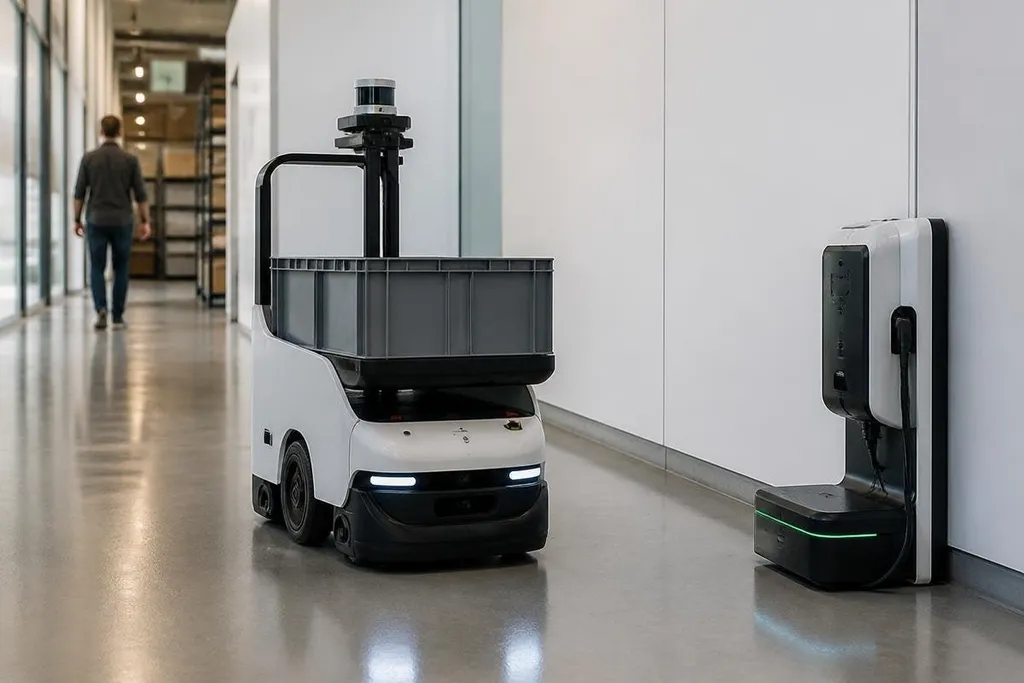
A mobile robot can have good sensors and careful software, then spend much of its working day charging. Battery limits shape how far it moves, what it carries, and where engineers can use it safely.
Charging remains a hard limit. The battery may remove part of it, but only if it stores enough energy without making the robot too heavy.
Quick read
- Battery weight cuts into payload, speed, and operating time.
- Fast charging helps only when the battery can handle heat and repeated charge cycles.
- Better cells matter most when the robot’s full work cycle has been measured.
Why battery weight changes the robot
A robot carries its battery through every step, wheel turn, and arm movement. More cells store more energy. They also add mass, which makes the motors work harder and can reduce the gain the designer expected.
This trade-off affects mobile robots in plain ways. A delivery robot may need to travel farther between charges. A warehouse vehicle may carry less stock. A legged robot may spend more power keeping its balance than moving across level ground.
Battery placement matters too. Engineers must spread the mass so the robot stays stable, leave room for cooling, and protect the pack from impacts. A smaller battery can make the machine easier to build, but a shorter work period may force more charging stops.
For industrial buyers, the useful number is not battery capacity on its own. It is the work completed before the robot needs a charger, including stops, empty travel, payload changes, and safety checks.
Stored energy is only part of the problem
A battery must send power when motors accelerate, a robotic arm lifts a load, or a legged machine catches itself after a misstep. A pack with enough stored energy can still struggle if it cannot supply that power without excessive heat or voltage loss.
Heat affects the whole system. Cooling hardware adds weight and takes space. High temperatures can also shorten battery life, so a robot built for long shifts needs control software that watches current, temperature, and charge level.
Charging brings its own limit. A fast charge can reduce downtime, but the robot needs a safe charging station and a battery pack designed for repeated high-current charging. Swapping packs may keep a machine working, though it adds spare batteries, handling equipment, and a process for checking pack condition.
The best choice depends on the task. A small inspection robot that returns to a dock often can use a different pack from a warehouse vehicle that must carry loads for hours.
What better cells could change
New battery designs may offer more energy for the same mass, but a lab result does not tell a buyer how the pack will work inside a robot. The full pack needs wiring, sensors, protection hardware, cooling, and a case.
Pack weight and price only matter alongside the robot’s model, task, and test setting. Battery reports from Robot24.com can tie those details to a real machine, so you can judge whether extra stored energy survives outside the lab. The next design choice is what to do with that added capacity.
A better pack could let designers reduce robot weight instead of adding more runtime. That may improve handling, lower motor demand, or leave more capacity for payload. It could also make smaller robots practical in places where charging space is limited.
Still, battery progress won’t fix poor grasping, unreliable navigation, weak safety systems, or expensive maintenance. Those problems remain in the robot’s sensors, software, mechanics, and work site.
Check the full work cycle before buying
Use these questions when a battery claim appears in a product sheet or pilot report:
- Measure the task: Ask how much time the robot spends moving, waiting, carrying loads, and stopped for safety checks.
- Check the payload: Find out whether the stated runtime includes the load you need the robot to carry.
- Count charging stops: Compare the pack’s charge time with the hours your operation needs each day.
- Ask about pack life: Request the expected charge-cycle count and the conditions used to measure it.
- Inspect the charger: Confirm the power supply, floor space, heat control, and spare-pack process.
- Separate proof from plans: Treat a cell result as an early technical result until a complete robot runs the task.
The strongest battery improvement will be the one that changes a robot’s work schedule, not the one with the best number on a cell datasheet. I’d judge any battery claim by completed work per charge, pack life, and the cost of keeping the robot moving.